
For me, THR Paddock is far more than a collection of race results. It is the digital memory of our community: a connected archive that brings together championships, races, drivers, cars, circuits, videos, Race Control decisions, personal memories and editorial reports.
I am pitman, and I conceived and developed the entire THR Paddock, including everything behind and around it. That includes the public platform, the admin area, the database structure, the import and analysis systems, the custom editing tools, the consolidation of the historic data and the editorial workflows used to maintain the archive.
What now looks clear, natural and accessible in just a few clicks first had to be collected from numerous different sources, checked, corrected and connected in a meaningful way. Much of this could not be automated. For me, it meant research, technical development, countless individual decisions and, above all, a great deal of manual work.
Even by a cautious estimate, I have invested more than 450 working hours in the development, research, verification and manual data maintenance behind THR Paddock.

THR history was not stored in one place
When I began this project, THR racing history did not exist in one central, consistent database. Over the years, the information had been created and stored in many different places.
Those sources included:
- current and older Server Manager data
- exported race results and lap data
- championship and event data from different stages of technical development
- Race Control decisions
- YouTube videos and additional video sources
- car and skin information
- circuit data and track maps
- corner names from sections.ini files
- historic maps and images found online
- race posters
- images stored on old hard drives and servers
- manual corrections and assignments
- personal memories, interviews, photographs and race reviews from the community
These sources did not always use the same names, structures or technical formats. Drivers sometimes appeared under different names or spellings over the years. Circuits existed in several versions and layouts. Cars had technical identifiers that did not necessarily match the names familiar to drivers. I had to reconcile old and new data without distorting the official history.
My real task was therefore not simply to import data. I had to turn many separate islands of information into one coherent and reliable data world.
An earlier idea helped shape the Paddock
Several years ago, margar17 came up with the idea of creating a THR Data Board. For that project, he imported data from Server Manager and we prepared it in Google Looker Studio.
We ultimately never published the Data Board. Nevertheless, the work was not lost. When I was developing the THR Paddock, I carried some of its statistical ideas forward and developed them into parts of the much broader archive that exists today.
The Data Board was an early attempt to make THR racing data visible. The Paddock took that starting point much further by connecting statistics with complete race histories, drivers, cars, circuits, media, Race Control, personal memories and editorial stories.
I would like to express my heartfelt thanks to margar17 for his original idea and for all the time and thought he invested in the THR Data Board back then.
The archive today
The live THR Paddock database now contains:
- 137 championships
- 641 events
- 1,487 sessions
- 1,068 race sessions
- 19,944 individual result records
- 502,898 recorded laps
- 1,227 drivers
These figures are only the technical foundation. The special value of the Paddock comes from the way these records are connected.
A lap belongs to a result. The result belongs to a session, the session to an event and the event to a championship. At the same time, the result is connected to a driver, a car, a skin and a circuit. Videos, Race Control decisions, track sections, images, statistics and editorial content are then added to the same history.
Only through these connections does a large volume of technical data become a useful motor racing archive.
The invisible part of the Paddock: the admin area
What users see in the public Paddock is only one side of my project. To bring all this information together, check it and publish it, I first had to develop an extensive custom administration area behind the scenes.
This is not merely a simple collection of input forms. It is the editorial and technical control centre of the entire archive. I created many of its functions because the historic data could not be processed reliably with existing tools.
It includes:
- management and monitoring of championship imports
- validation of different data formats and historic data states
- classification of championships and individual events into seven event types
- editing championship names and other metadata
- uploading, assigning and managing race posters
- automatic detection of the main colour in each poster
- manual assignment and verification of YouTube videos
- assignment of Race Control decisions to events and sessions
- storage of permanent manual corrections
- management of car and skin images
- checks for missing images and tools to restart technical retrieval attempts
- management of circuit maps
- research and storage of external map references
- import of available sections.ini information
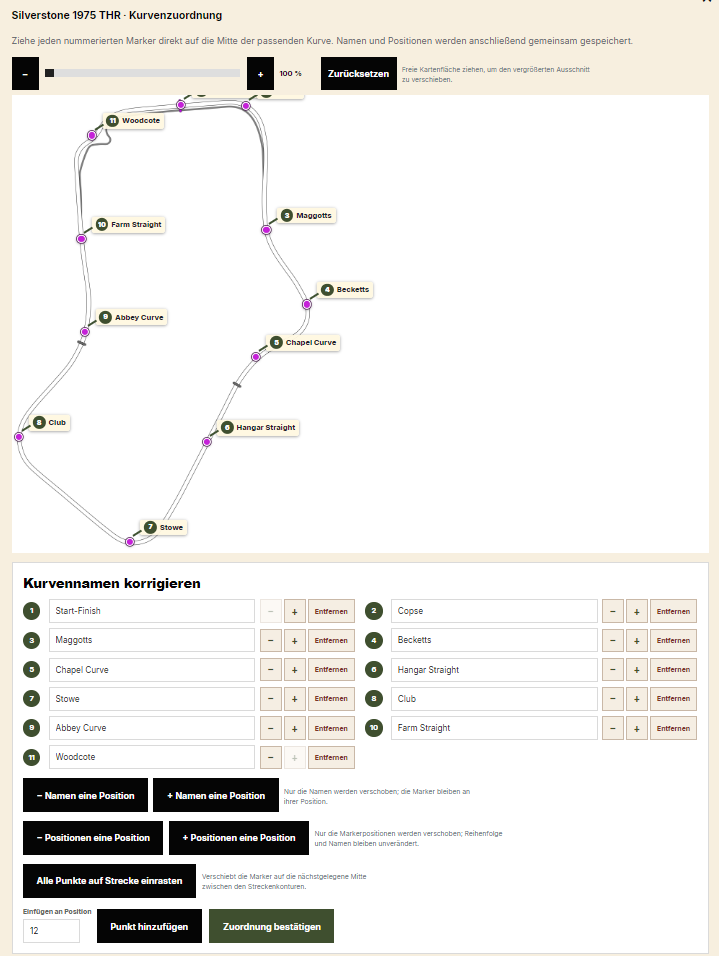
- a dedicated editor for creating, naming, moving, ordering and confirming corner points
- queues for generating race reports and season reports
- editorial editing, checking and publishing of those reports
- tools for inspecting and repairing historic data assignments
- a preview, repair, backup and rollback workflow for reconstructing historic starting grids
- updating and fully rebuilding THR Performance Rating
- status displays, progress checks and database updates
- a dedicated analysis of project figures from the live database
I did not plan all of these tools in their final form from the beginning. They emerged during the work whenever I discovered that certain data could not be assigned or checked reliably through automation alone.
A newly discovered problem therefore often led me to do more than make a single correction. I developed a new feature so that every comparable case could be handled properly. Alongside the public Paddock, I gradually built a complete system for importing, researching, assigning, checking, correcting and publishing.
The manual work was not simply a matter of entering data into ready-made fields. In many cases, I first had to design and develop the fields, editors, validation mechanisms and administrative workflows myself.
The admin area also makes an important difference for the future. The collected information is not a one-off snapshot. It can continue to be corrected, expanded, checked and recalculated. THR Paddock is therefore not a finished data project, but a permanently maintainable archive.
I classified every championship and race
I had to assign an event type to all 137 imported championships and all 641 events. This classification matters because not every race has the same sporting significance and not every event should appear in the same statistics.
The Paddock currently distinguishes between:
- 46 Main Event championships with 246 events
- 45 Practice Race championships with 187 events
- 9 Casual Race championships with 59 events
- 6 Special Event championships with 8 events
- 20 Fun Event championships with 38 events
- 7 Endurance Race championships with 6 events
- 4 Weekday Race championships, one for each year in which we held WKDY races, with 97 events
I made these assignments to ensure, for example, that a Practice Race was not accidentally treated as an official championship round and that a Fun Event did not silently enter regular championship statistics.
What now appears to be a simple filter in the Paddock is based on my editorial classification of 778 records: 137 championships and 641 individual events.
The particularly difficult years before Server Manager
A large part of older THR history comes from a time before the current data structures existed. Historic results could not simply be transferred from one consistent system.
I had to find, read and compare old files before assigning them to the correct events. I had to recognise and combine different spellings, and supplement missing details from other sources wherever they could be established with confidence.
Throughout this work, I had to separate technical plausibility from historical truth. My purpose was not merely to display old data somehow, but to preserve it in a way that respected the official classification and the actual course of THR history.
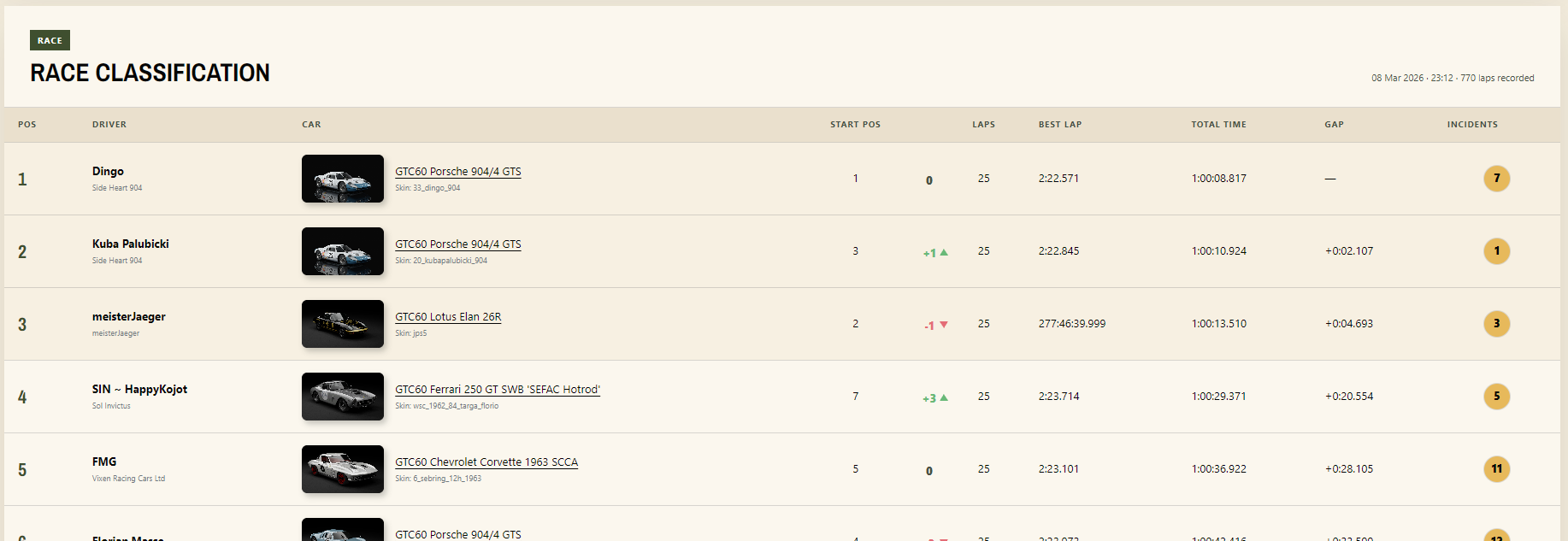
A result contains far more than a position and a time
At first glance, a race result appears simple: a driver, a position and a race time. In the Paddock, considerably more lies behind it.
Depending on the available source data, the system connects:
- starting and finishing positions
- positions gained or lost
- completed laps
- personal and overall fastest laps
- gaps and race times
- driver identities
- car models and skins
- team and class assignments
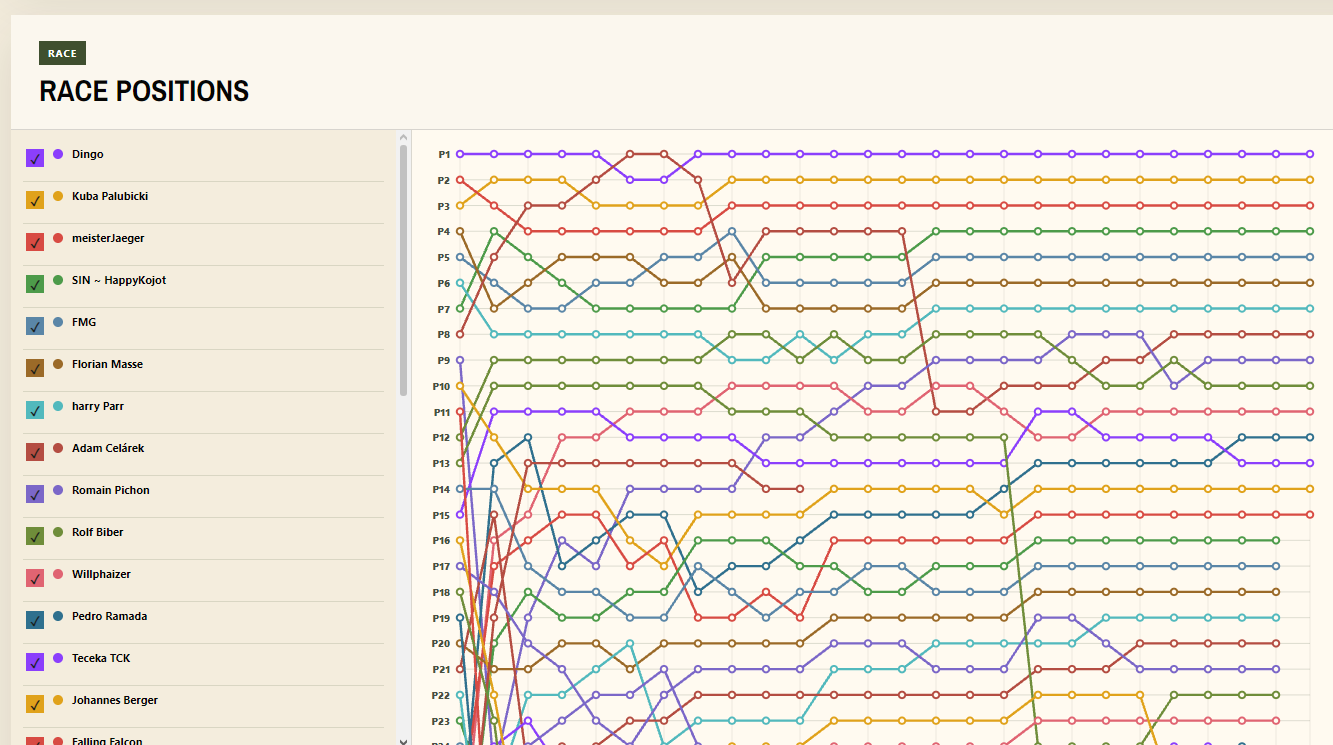
- position development
- contacts and incidents
- Race Control decisions
- championship points and dropped scores
- videos and editorial reports
These connections create functions that go far beyond a conventional results table.
Reconstructing the correct starting grids
One of the most complex pieces of historical correction was determining the actual starting position of every driver in every championship race. Over the years, THR used many different event and session configurations. There was no single field that could simply be imported in the same way for every race.
Depending on the championship, the grid could be based on a conventional qualifying session, a combined practice result used as qualifying, a qualifying session stored in a separate event, the result of an earlier race, a reversed grid or technical car and entry order data. Other cases included drivers without a qualifying time, competitors joining only for a later race and endurance events in which one result represented an entire team.
I therefore developed procedures that examine each championship in its full historical context. They compare sessions, events, circuits and dates, identify drivers and teams through several available identifiers and select the appropriate source for each starting position. The process also distinguishes between reliable recorded grid data, reconstructed positions and cases that still require individual review.
Because a correction of this scale must remain verifiable, the administration tool first creates a detailed preview. It shows the proposed source and result, reports warnings and unresolved cases and only applies a complete repair when the run is free of errors. Every changed starting position is backed up and can be restored if necessary.
This work is important far beyond the grid column itself. Correct starting positions are the foundation for positions gained or lost, meaningful race analysis, historical reports and several statistics. What users now see as a natural part of the race classification is based on extensive reconstruction across many differently configured championships.
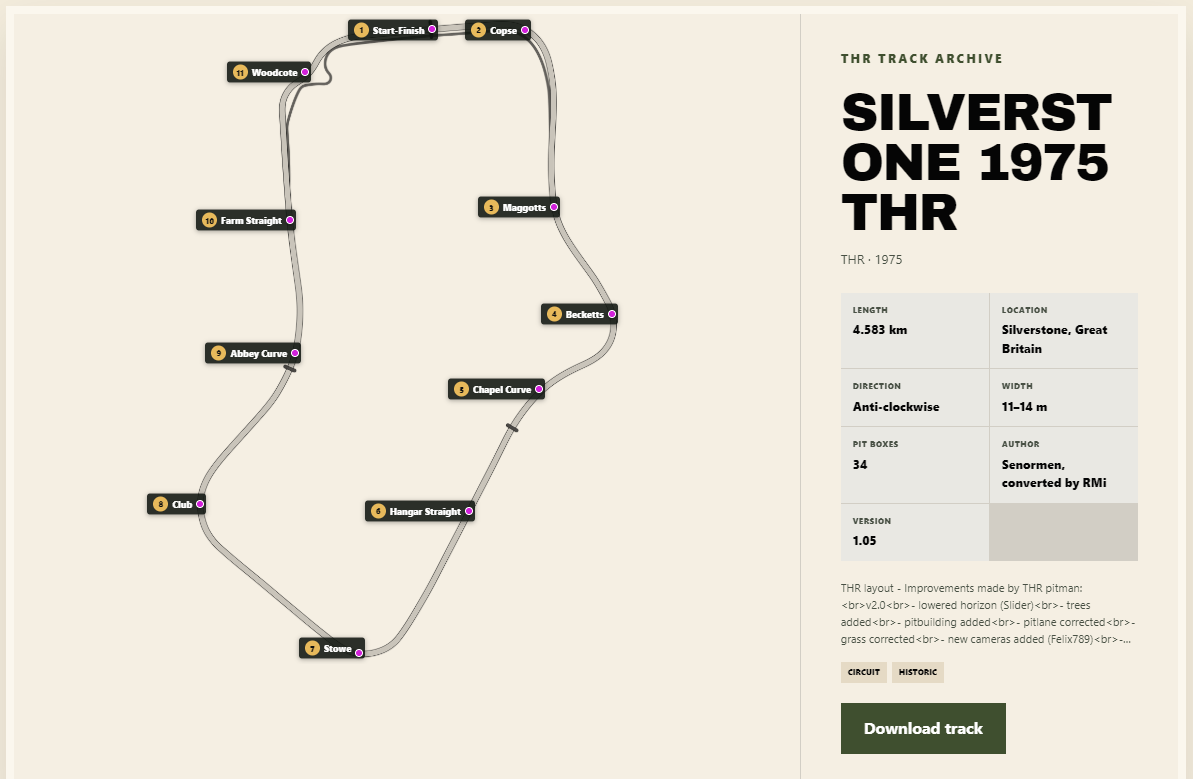
212 circuits and 2,718 confirmed corners and sections
Preparing the circuits became a major project in its own right for me.
The Paddock currently contains:
- 212 technical circuits
- 253 different layouts
- 238 layouts with corner names
- 2,718 corners and track sections
- 2,718 confirmed corner and section points
- 42 stored web references
Later, I introduced support for reading existing sections.ini files, which helped with part of this work. By that point, however, I had already processed a very large number of circuits. Even after the new option became available, I still had to work manually on more than 100 circuits.
In total, I manually edited an estimated 150 circuits or layouts. For around 80 percent of them, approximately 120 layouts, I assigned the corners substantially by hand.
Depending on the circuit, this work involved:
- finding historic maps or suitable images online
- matching the visible circuit with the technical track map
- researching corner and section names
- creating new corner points in the editor
- typing names by hand
- moving points into the correct positions
- correcting the order of corners
- checking and confirming the complete result
My manual effort averaged approximately five to ten minutes for each circuit that required editing. Technical assistance helped me with some of the data, but it did not replace the necessary checking and correction.
80 race posters give events their own identity
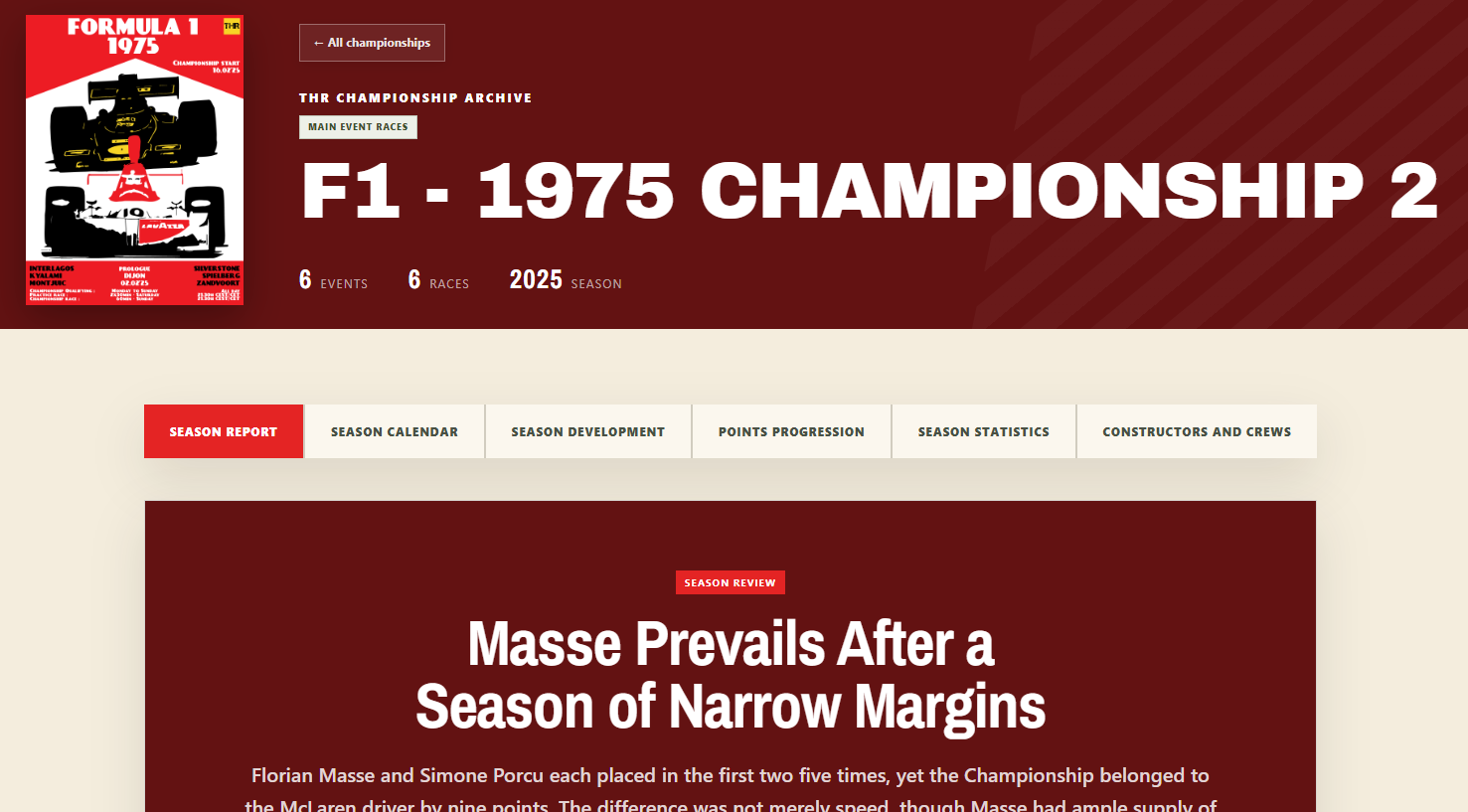
I researched, uploaded and assigned suitable race posters for every Main Event, Casual Event, Special Event and Endurance Race. In addition, I gave twelve Fun Events their own posters.
THR Paddock now contains 80 race posters in total.
The work does not end with uploading the image. The Paddock analyses the dominant colour of each poster and uses it to create an individual theme for the corresponding championship and race pages. This automatic page colouring is enabled for all 80 posters.
As a result, each event receives not only a historic image, but its own visual identity within the Paddock.
2,350 car skins, each with its own image
The Paddock now records 2,350 different car skins. A locally stored image is available for every one of them.
I could retrieve some of these images from existing technical sources. For more than 100 car images, however, I had to search old hard drives and servers, recover the files and then add them manually.
The current database can no longer distinguish retrospectively between images obtained automatically and those rescued through this manual work. The figure of more than 100 manually added images is therefore based on the records and recollection of that original recovery process.
Without this search, some older cars would still exist as result records in the archive, but would no longer have a visible face.
The official classification remains the official classification
Historic data is not always as straightforward as it first appears. Technical results can differ from the classification published later. Drivers may receive penalties, lose positions or be disqualified after the race. Older events may also involve special rules, class classifications or dropped scores.
I therefore took particular care to distinguish between the original technical data and the official THR classification.
Corrections are not simply written invisibly over the old information. Where necessary, they are stored as permanent assignments or overrides. This makes it possible to understand which classification the Paddock uses and why.
454 Race Control decisions were assigned
THR Paddock currently contains 454 Race Control decisions. Every one of them is assigned both to an event and to a specific session.
There are 188 permanent manual overrides. These were required where an automatic assignment was not reliable enough or where historic names and dates did not match clearly.
Once again, my work involved more than importing a list. I had to read and check the decisions before assigning them to the correct race and session.
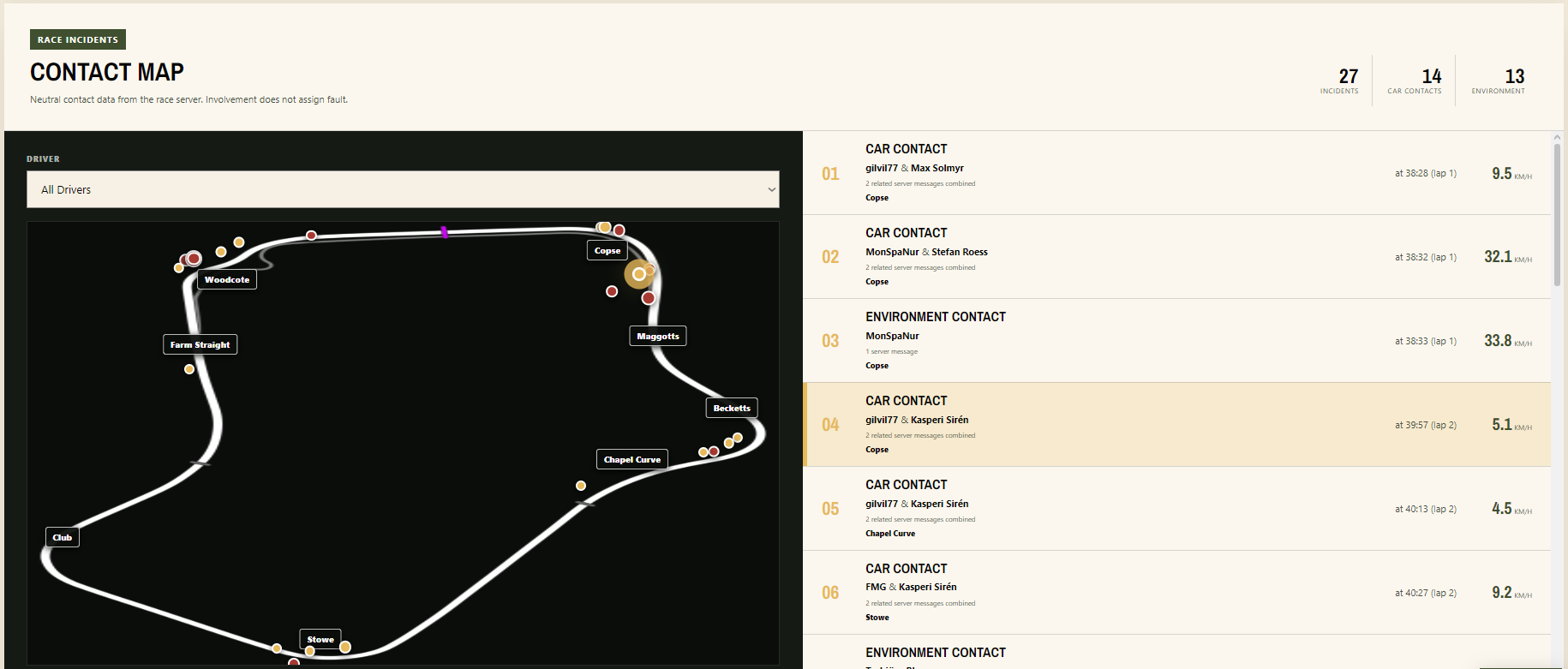
Where suitable data is available, the Paddock also connects contacts and incidents with the confirmed corner names of a circuit. It can therefore show not only that something happened, but where on the circuit it took place.
Almost the entire video archive was checked individually
The Paddock contains 254 stored video links:
- 70 videos were assigned primarily to an event by hand
- 13 additional videos were added manually
- 240 links were checked in total
A video often uses neither exactly the same event name nor the same spelling as the corresponding database record. I therefore had to compare titles, dates, circuits and championships.
The result is a video archive that does not sit separately beside the racing data. Recordings appear where they belong historically, directly with the corresponding event and race.
The Story Analyzer finds the stories hidden in the data
Before an AI can turn a race into a readable report, the relevant stories first have to be identified reliably. For this purpose, I developed the Story Analyzer. It is a deterministic analysis system built specifically for THR Paddock. It does not call an AI service and does not invent a narrative. Instead, it examines the verified race data and determines which developments are actually supported by the archive.
For every eligible race, the Story Analyzer combines the classification, starting positions, lap data, position development, fastest laps, incidents, Race Control decisions, circuit information and the championship situation as it stood immediately after that event. It also compares the race with suitable historic benchmarks from the same type of event.
Depending on the available data, it can identify:
- close finishes and unusually close fastest-lap contests
- strong recoveries from the starting grid
- pole-to-win performances and unexpected podium results
- lead changes, sustained battles and groups of closely matched drivers
- dominant phases, late pressure and consistent pace
- victory milestones and winning streaks
- changes in the championship lead or points gap
- decisive championship outcomes and final classifications
- penalties, Race Control decisions and relevant incidents
- verified incident locations using the confirmed corner names
- useful historic circuit context, conditions and tyre information
The Analyzer records both accepted and rejected story signals. A possible story is only passed on when the necessary evidence is available and the defined thresholds are met. It also creates an editorial plan that distinguishes the main story from supporting themes. This prevents every available statistic from being treated as equally important.
I developed these checks through many iterations because apparently simple conclusions can be misleading. A small intermediate gap is not automatically a close finish, a position change does not reveal where or how an overtake occurred, and final championship knowledge must not be projected back into an earlier race.
The verified signals and the historical snapshot produced by the Story Analyzer then become part of the structured data package used for the race report. The AI writes the prose, but the Story Analyzer establishes which stories can be told and which claims the data actually supports.
66 race reports and 10 season reports
THR Paddock already contains 66 race reports and 10 season reports. All 76 reports have been published.
These reports are not generated automatically in the background. I start every race report and season report manually, check the result on a sample basis and only publish it afterwards.
To prevent the articles from reading like automatically generated result summaries, I refined the information passed to the AI through many iterations. I also adjusted and expanded the editorial instructions repeatedly.
The current race report prompt is version 23 and contains:
- 17,628 characters
- 2,606 words
The season report prompt is version 16 and contains:
- 14,420 characters
- 2,026 words
Together, that amounts to 32,048 characters and 4,632 words of fixed editorial rules and quality requirements before the individual data package for a race or season is even supplied.
These instructions define, among other things:
- which information can be treated as verified
- which stories are relevant to a report
- how race development should be turned into a coherent narrative
- how drivers and cars must be identified correctly
- how partial distances, retirements and disqualifications must be handled
- how historical championship standings must be treated
- how dropped scores must be considered
- which conclusions must never be drawn without evidence
- how repetition and simple result lists should be avoided
- which linguistic and editorial style the reports should follow
The Paddock therefore does not use AI as a replacement for editorial work. The quality of the reports depends on structured data, extensive rules, many development cycles and subsequent human review.
The Paddock tells stories, but it does not invent them
One of my central development goals was to discover interesting stories in the available data without giving that data more meaning than it can genuinely support.
A close gap during a race is not automatically the gap at the finish. A position change between two laps does not prove at which corner or in what manner an overtake occurred. A shorter race distance does not automatically establish a mechanical retirement. The final championship standings must not influence a report written from the perspective immediately after an earlier race.
These distinctions may appear small, but they determine whether a historic report remains reliable or accidentally invents events.
I therefore built numerous safeguards and editorial rules into the Paddock to prevent a statistical observation from becoming an unsupported claim.
A personal archive for every THR member
The Paddock preserves not only races, but also the history of the people who took part in them.
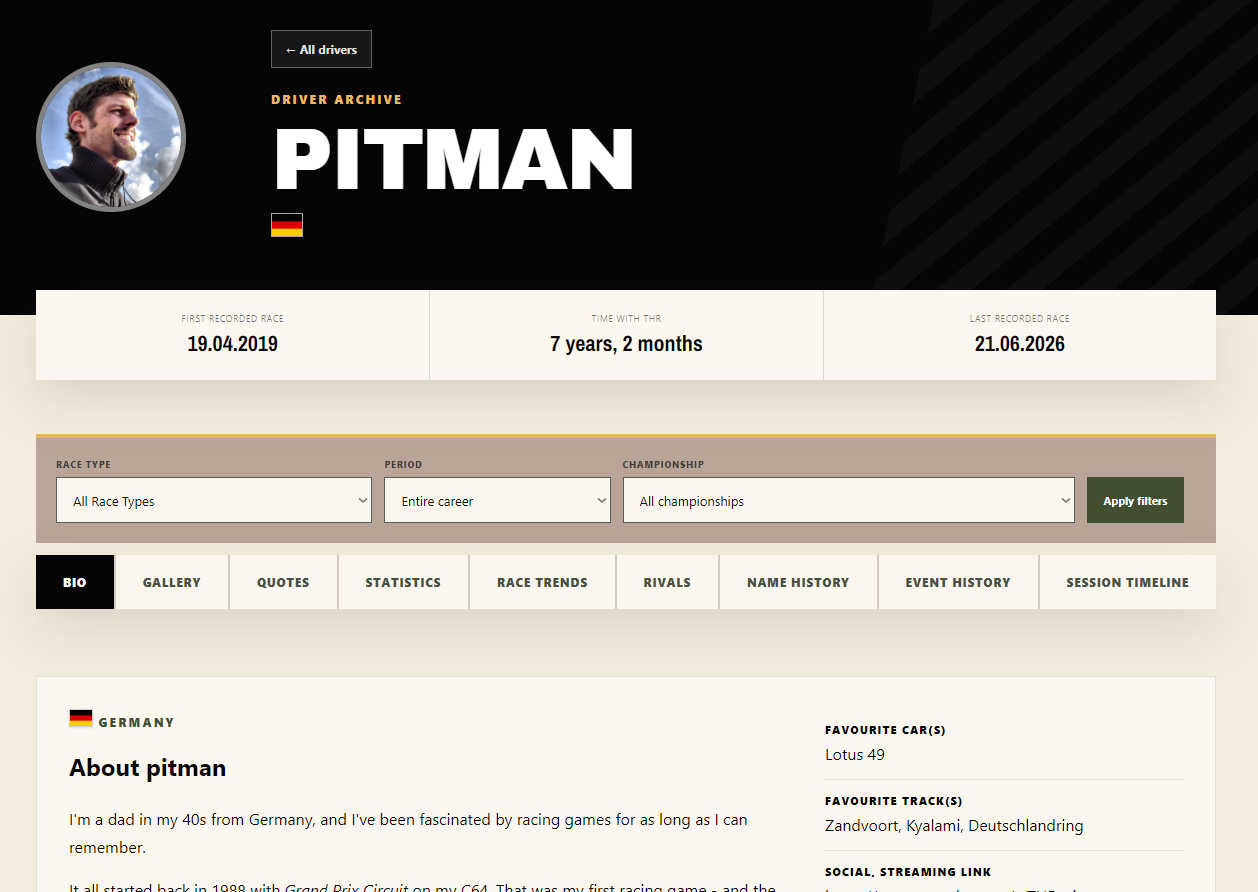
Driver profiles connect:
- all starts and results
- wins, podiums and fastest laps
- cars and skins used
- preferred circuits
- team-mates and rivals
- positions gained and race development
- personal photographs
- their own race-specific YouTube and Twitch broadcasts
- interviews
- memories and personal race reviews
Through the protected Driver Login, every member can contribute this material only to races in which their own verified driver identity participated. The Own Broadcast area accepts specific YouTube videos and Twitch videos or clips, but not general channel or profile links. On each race page, the official THR recording remains first, while the drivers' onboard streams and personal broadcasts add further perspectives underneath it.
This turns a technical name in a result file into a connected THR racing career and lets the people in the race add their own view of what happened.
THR Performance Rating makes performance comparable
With THR Performance Rating, I have added another particularly sophisticated analysis to the archive. The system is inspired by Multi Elo and considers more than wins, podiums or championship points. It evaluates how a driver performed in direct comparison with the entire field in each race.
Every driver begins with a rating of 1,000. Before each eligible race, the system calculates the expected performance of every participant from the ratings accumulated so far. It then compares that expectation with the actual finishing order.
A driver who performs better than expected gains rating points. A driver who finishes below expectation loses points. The strength of the opposition also matters. A strong result against highly rated drivers can therefore be worth more than the same position in a field with lower ratings.
The rating is rebuilt through every historic race in chronological order. This produces not only a current ranking, but a complete development curve for every driver. For each eligible race, the Paddock stores:
- the rating before the race
- the change caused by the result
- the rating after the race
- the rated finishing position
- the size of the field
- the driver's personal peak rating
Alongside the overall THR Performance Rating, separate ratings are calculated for Main Events, Casual Events and Special Events. This makes it possible to examine both long-term performance across THR and performance within different kinds of event.
In genuine multiclass races, each class is evaluated as a separate field. Drivers are compared only with the other participants in their actual class. Practice Races, Fun Events, Endurance Races and events explicitly identified as non-scoring prologues are excluded. The team-based 2nd Anniversary Race is also excluded.
A driver receives an official ranking position after five eligible races. Until then, the rating is shown as provisional. This prevents one strong result from immediately appearing to represent an established long-term level of performance.
THR Performance Rating is deliberately an additional and experimental analysis. It does not replace official race results, championship tables, titles or records. Instead, it offers a new perspective on THR history. How did a driver's performance develop over the years? Who achieved particularly strong results against highly rated opposition? When did a driver reach a personal peak? How did individual races change the long-term picture?
The results are connected throughout the Paddock. Each race page shows how that race changed the rating of every driver. Driver profiles show the current value, ranking position, personal peak, number of rated races, latest change and best individual gain. A dedicated ranking and interactive development charts also allow several drivers to be compared across their complete THR careers.
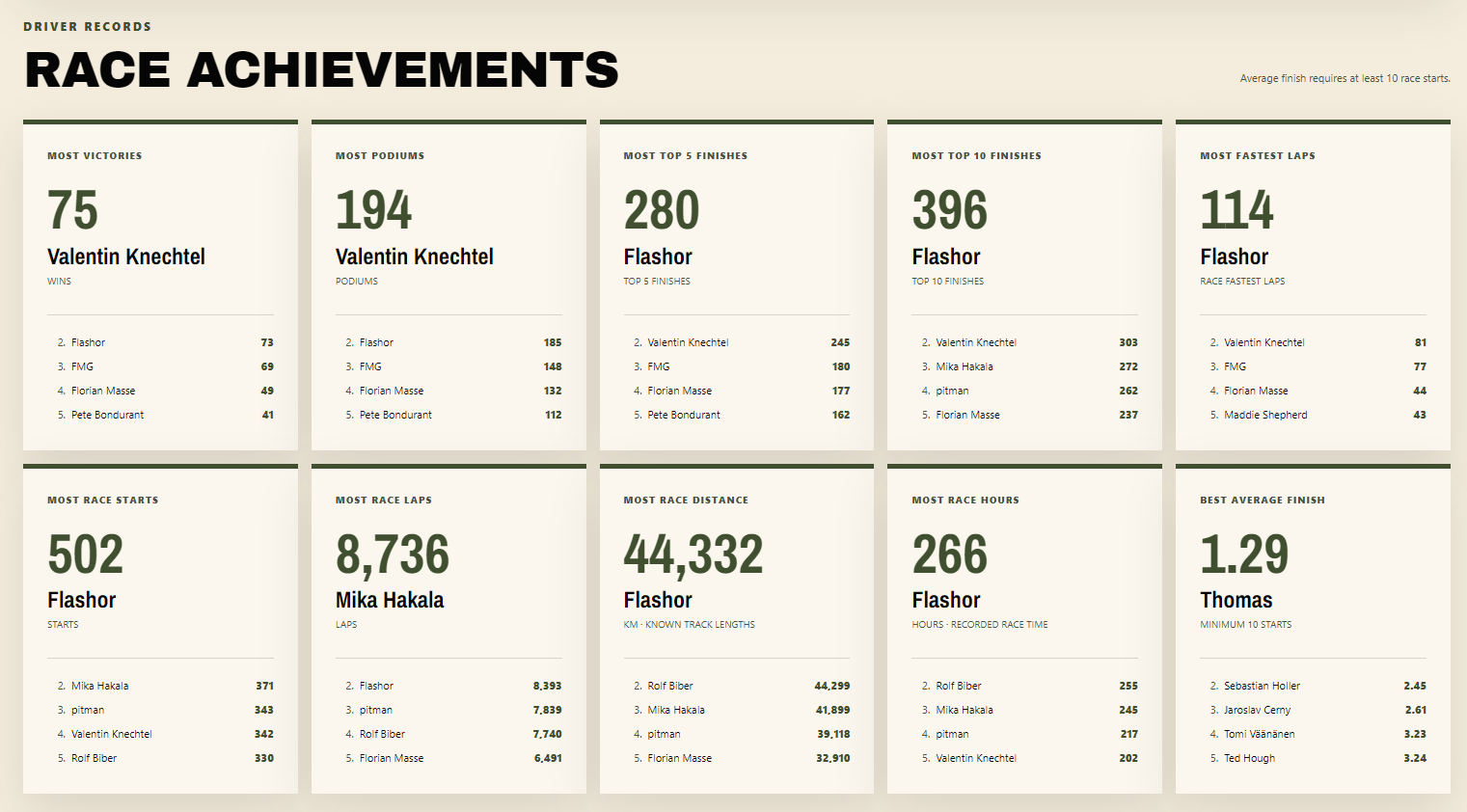
In this way, the Paddock turns more than half a million stored laps and thousands of race results into another connected historical perspective. The system shows not only who was ahead on a particular day, but how performance developed across many races, changing fields and different eras.
What the community now has at its disposal
By bringing all these different sources together, THR Paddock now provides:
- a searchable archive of all imported championships and races
- detailed race classifications
- personal driver profiles
- car and skin archives
- circuit maps with confirmed corner names
- graphical position development
- Race Control decisions and incident assignments
- a verified video archive with official THR recordings and race-specific driver broadcasts
- championship tables and historic points development
- race reports and season reports
- THR Performance Rating with rankings and development charts
- records, rankings and long-term statistics
- personal images, own race broadcasts, interviews and memories from the community
Many of these features could already be separate projects in their own right. In the Paddock they work together and draw from one shared historical foundation.
Around 900 development, test and upload states
I did not develop the Paddock in a few large steps. On the way to the current system, I created around 900 documented development, test and upload states.
Each of these states could contain new features, data corrections, presentation changes, import improvements or additional safeguards. Many changes also required renewed checks against both old and new championships.
A substantial part of my development work took place in the admin area that ordinary users never see. Historic special cases repeatedly required me to create new tools for importing, checking, assigning and correcting information.
The visible Paddock is therefore not the result of one import or one major development step. I built it through hundreds of iterations.
More than 450 working hours and additional costs
I can no longer calculate the total effort to the minute. I completed a great deal of the work before I began using ChatGPT or comparable technical assistance. This included manual research, assigning videos and Race Control decisions, preparing circuits, recovering old car images and classifying historic events.
In addition came concept development, programming, data migration, development of the admin area, verification, error analysis, prompt development and hundreds of development and upload cycles.
Even by a cautious estimate, I have therefore invested more than 450 working hours in the development, research, verification and manual data maintenance behind THR Paddock.
In addition to this working time, the project has created extra costs for technical infrastructure, external services and tools used for data preparation and analysis. These expenses are significantly higher than THR's normal monthly costs.
A digital memory for THR
The true value of THR Paddock does not lie in its impressive numbers alone.
It preserves connections.
It shows not only who won a race, but who they raced against, which car they used, how the positions developed, which circuit was used, what Race Control decided and which images, videos and memories belong to that event.
The result is something that is far from standard even in real-world motor racing: a detailed, connected and permanently accessible archive of an entire racing community.
With THR Paddock, I have created a place where the complete racing history of our community can remain accessible and continue to grow.
THR Paddock does not simply preserve results. It preserves our shared history.
Support THR
If you enjoy using the Paddock, value the work behind it and would like to support THR, we greatly appreciate either a contribution through PayPal or regular support through Patreon.